Compact block filter chain source for ldk-node
Recently I’ve finished (jointly with febyeji) work on a compact block filter (CBF) chain source for ldk-node (PR #828).
I’d like to share some details and design behind it.
ldk-node and LDK
LDK is a set of primitives to use Lightning Network, and ldk-node builds on it (together with BDK) to give a ready-to-go interface for building Lightning applications. Both LDK and ldk-node are libraries: they have no executables, but serve as building blocks for user applications. A standalone lightning node application by LDK is ldk-server.
Onchain information
Lightning Network nodes need to interact with the blockchain (otherwise they would be completely unrelated to bitcoin). They need the following from the chain:
- current tip height (to know HTLC expiries)
- channel opening (funding transaction confirmation)
- force close (commitment transaction broadcast)
- revoked commitment broadcast
- splice in/out
- onchain wallet transactions
- broadcast own transaction and know fees
ldk-node abstracts the onchain interaction through the ChainSource—something that can provide info about the blockchain.
Chain sources differ in how the onchain information is fed to the ldk-node. They either provide full blocks (Listen trait) or only some specific transactions (Confirm trait).
There are four chain source implementations:
- bitcoind: we connect to a real bitcoin node and download all blocks,
- esplora: we ask an indexing server about specific transactions; it also can tell which transactions pay or spend from the wallet’s scripts,
-
electrum: the same as esplora over a different protocol,
- compact block filter (see below)
Electrum and Esplora leak privacy: service operators know which transactions and scripts we’re interested in and thus can link payers and destinations.
Bitcoind (our own node) does not leak privacy, but is a far more resource-hungry service, which is unsuitable, for example, for mobile phones: running a full node there is impractical.
Compact block filter node (kyoto)
There is another way we can learn about the chain: via compact block filters. They were introduced as BIP157/BIP158.
Block filter itself is a piece of data about the block which can tell whether a particular script was involved in this block (with rare false positives). BIP157 makes them verifiable, i.e. nodes cannot put arbitrary information there (not entirely1). We can request these filters from the bitcoin network.
Filters do not provide information what transaction did, it means one has to download the whole block in that case. Though it is still a big improvement, as a typical filter is less than 30KB, while a full block is typically 1–2 MB (up to about 4 MB). And of course matching transactions occur quite rarely.
There is a Rust implementation of this specification—Kyoto.
How it works
Kyoto is a node, which means it manages peers and exchanges messages with them. That’s why it has a few more parameters to build than other chain sources.
Kyoto itself is also a library, meaning it doesn’t have an executable, but can be easily embedded into other software.
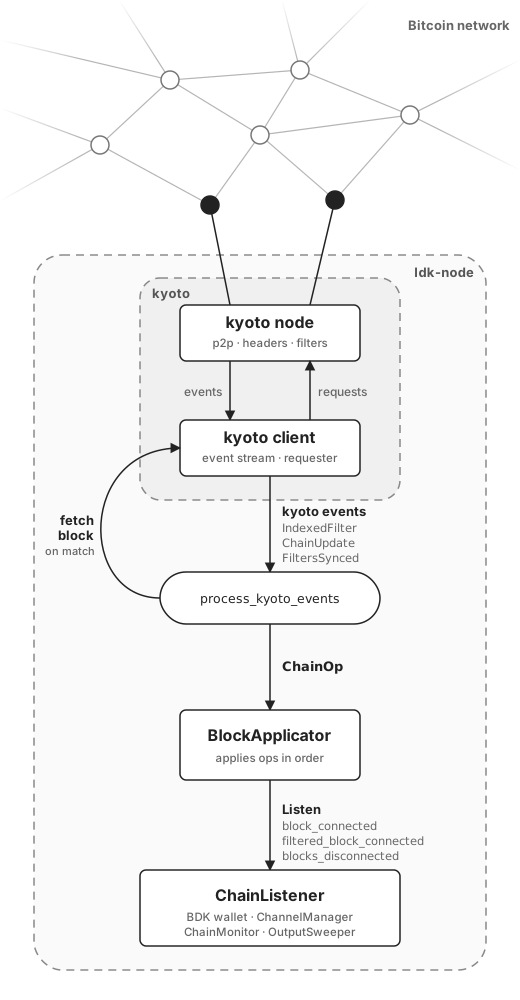
It is divided into two parts: a node, which handles the node activity; and a client, which sends the information to the user application as well as allows control of the node.
Kyoto downloads three types of data:
- headers
- compact block filter headers
- compact block filters themselves
The client feeds this data as chain events to the consumers, these events are:
ChainUpdate: the header chain changed: a new header was connected, a reorganization happened, or a fork was addedIndexedFilter: a compact block filter with its height and block hash; it carries the data needed to test whether a particular script belongs to the blockFiltersSynced: kyoto has scanned the whole requested range, i.e. it is caught up with the tip
Resources
Kyoto keeps the headers it has downloaded in memory, and streams the filters to the application instead of storing them. So its memory use is proportional to the number of headers, roughly half a kilobyte each (80 bytes on the wire).
ldk-node does not sync from genesis: it resumes from the last block its components have seen (minus a few blocks for reorgs), so only the headers since then are kept. For example, syncing from a year ago (about 52k blocks) takes roughly 20–30 MiB for the headers. For comparison, a sync from the taproot activation checkpoint (about 263k headers) peaked at around 190 MiB, and one from genesis (about 950k headers) at around 740 MiB. The sync time is bound by the network, not by the CPU.
Compact block filter chain source
The main idea is to maintain some set of watched scripts, listen for events from kyoto and then act accordingly. Let’s get into more detail.
Node building and setup
Unlike other chain sources, we’re running the blockchain node in a tokio task, thus we have full control of it and have to monitor whether it is running, has stopped or needs some attention.
Tracked scripts
There are two types of scripts tracked, ones provided by the onchain wallet and others are LDK-specific
(ChannelManager, OutputSweeper, ChainMonitor—all of them are bound together in ChainListener).
The set of tracked scripts might get updated when we reveal a new address or broadcast a tx. We need to keep it
up-to-date to avoid missing a tx.
BDK has its own watched scripts, so keeping a copy could miss some tx due to asynchronicity. Instead each
time we need a list of watched scripts, we take it from BDK, maintaining a single source of truth. For LDK scripts
we add a new script each time LDK asks us to watch something through its Filter trait (register_tx and register_output): the funding transaction of a channel, the funding output of a splice, the outputs of a commitment transaction once it confirms, or an output the sweeper is about to claim.
LDK’s watched scripts live in CbfChainSource. On start they are initialized by ChainMonitor and OutputSweeper, which register all the scripts they need.
Processing kyoto events
After the node is started, we listen to kyoto’s events and process them in chain source’s process_kyoto_events.
It takes the event (a compact block filter), checks whether it contains a script we’re interested in (if so, it downloads the block) and sends the
appropriate ChainOperation to another entity—BlockApplicator.
BlockApplicator
BlockApplicator does what its title says: applies block operations, advancing the consumers (the onchain wallet, ChainMonitor,
ChannelManager, OutputSweeper), all of which are bound together in ChainListener. It is a distinct entity to simplify design: events arrive asynchronously and fetching
a block takes time, so operations are queued and applied one by one in chain order.
Staying in sync
Once all events up to ChainOp::Synced are processed, we are up to date and have seen every transaction we care about. FiltersSynced alone is not enough: blocks may still be waiting to be applied, which is why Synced goes through the same queue.
Broadcast and fee sources
Kyoto does not have a mempool, but can broadcast transactions to other peers. The absence of a mempool means we cannot observe unconfirmed transactions, so, for example, we cannot tell whether an RBF replacement was accepted by the network until a block confirms one of the transactions.
To build transactions (and for LDK’s fee decisions) one needs current fee rates. Without a mempool there are three options for that:
- use esplora fee data
- use electrum fee data
- fallback native fee resolution
First two options can use any public service, as they reveal nothing about our wallet by simply asking a provider what the current fees are (of course, the provider would know our IP).
If there is no electrum/esplora fee provider, one can use fee calculation from recent blocks. For that CbfChainSource
downloads the last 14 blocks and calculates the fees paid there by included transactions and estimates
the next fees. This option is only a fallback one, as it forces us to download every new block, which completely undermines
the whole purpose of a CBF node.
Choosing the wallet birthday
When the node is started for the first time, the wallet is created with its birthday set to the current chain height. The problem is that we don’t know the height without a synced chain source. The solution for that is to run kyoto in headers-only mode during the build. It syncs the header chain (which takes up to 15 seconds) to obtain the current tip height.
Try it
I am running a public node on Mutinynet (a custom signet), which you can try: ldk-cbf.yyyyy.io. It runs ldk-server with this chain source, and the page is a dashboard showing the state of the node and kyoto’s peers.
-
A BIP158 filter contains the scripts of the outputs a block creates and of the outputs it spends. The former are in the block itself, the latter live in earlier blocks, so a filter cannot be fully verified against its block alone: that would require the input scripts. What a client can do is compare filter headers across several peers and download the block when they disagree, so a single rogue peer is detectable, but a filter served by a rogue node cannot be proven complete on its own. ↩